
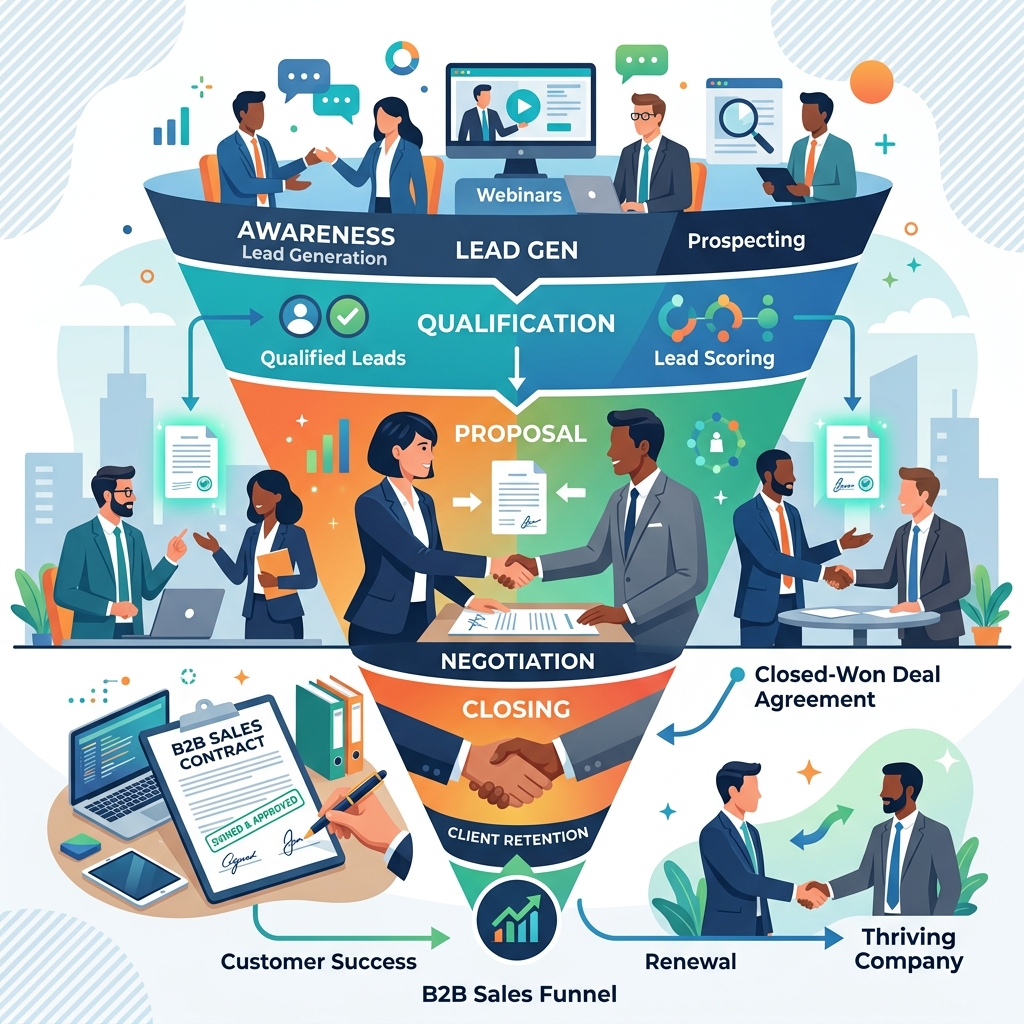
Accelerating B2B Sales Funnel Velocity: How to Close Deals Faster
In B2B sales, time kills all deals. If your average sales cycle stretches beyond 90 days, your customer acquisition cost (CAC) skyrockets, your cash flow stagnates, and the probability of losing the prospect to a competitor or the status quo increases dramatically. Accelerating your sales funnel velocity is the most effective way to improve your marketing ROI and scale your revenue.
What is Sales Funnel Velocity?
Sales funnel velocity (or pipeline velocity) measures the speed at which opportunities move through your sales process, from initial contact to closed-won. It's not just about closing deals; it's about closing them efficiently. A higher velocity means your sales team is highly productive, and your revenue generation is predictable.
The Four Levers of Sales Velocity
To improve your velocity, you need to understand the mathematical formula behind it. Pipeline velocity is driven by four key metrics:
- Number of Opportunities: The total number of qualified leads in your pipeline.
- Average Deal Size: The average monetary value of a closed-won deal.
- Win Rate: The percentage of opportunities that turn into closed-won deals.
- Length of Sales Cycle: The average number of days it takes to close a deal.
Formula: (Number of Opportunities × Average Deal Size × Win Rate) / Length of Sales Cycle
To accelerate velocity, you must increase the top three metrics while actively decreasing the length of the sales cycle. Let's break down how to optimize each stage of the funnel.
Identifying Bottlenecks in Your Pipeline
The first step to acceleration is diagnosing the friction points. You must meticulously track the conversion rate between every single stage of your funnel. This requires a well-maintained CRM and disciplined data entry by your sales team.
- Top of Funnel (MQL to SQL): Are marketing-qualified leads stalling before becoming sales-qualified? The lead scoring criteria might be misaligned, or the initial outreach cadence might be too slow.
- Middle of Funnel (Demo to Proposal): If 50% of prospects drop off after the initial demo, your presentation is flawed. It might be too feature-focused rather than addressing the specific pain points of the prospect.
- Bottom of Funnel (Proposal to Closed-Won): If deals consistently stall at the contract phase, your pricing might be too complex, your legal terms too rigid, or you haven't built enough consensus among the buying committee.
Strategies for Acceleration
Once you've identified the bottlenecks, implement these targeted strategies to grease the wheels of your sales machine.
1. Ruthless Qualification (Disqualify Faster)
Counterintuitively, one of the best ways to speed up your sales cycle is to get rid of bad leads faster. Sales reps often waste months chasing prospects who lack the budget, authority, or genuine need for your solution. Implement strict qualification frameworks like BANT (Budget, Authority, Need, Timeline) or MEDDIC early in the process. A quick "no" is the second-best answer in sales; a lingering "maybe" is the worst.
2. Multi-Threading the Buying Committee
In modern B2B sales, a single decision-maker rarely signs off on a significant purchase. The average buying committee consists of 6 to 10 stakeholders. If your rep is only talking to one champion, the deal will stall when it hits the procurement or executive level.
Multi-threading involves building relationships with multiple stakeholders across the organization simultaneously. Address the specific concerns of the end-user, the financial buyer, and the technical evaluator early in the cycle to build consensus and avoid late-stage objections.
3. Streamlining the Proposal and Contracting Process
The proposal phase should not be a massive hurdle. Standardize your pricing models and create modular proposal templates that can be customized quickly. Simplify your legal terms and utilize e-signature software to remove administrative friction.
Consider offering 'fast-track' clauses for smaller deals to bypass lengthy procurement reviews, or implement automated approval workflows within your own organization to ensure quotes are sent out within hours, not days.
4. Utilizing Sales Enablement Content
Your buyers will do significant independent research before ever speaking to a rep. Arm your champions with high-quality, targeted content that they can share internally to build your case for you. This includes ROI calculators, detailed case studies, technical whitepapers, and competitive battle cards.
When reps can instantly provide exactly the right piece of content to overcome a specific objection, the deal moves forward immediately instead of stalling for a week while marketing scrambles to create collateral.
5. Creating Urgency (Without Being Pushy)
Deals often stall because the prospect feels no urgency to act. "The status quo is fine for now." Your job is to quantify the cost of inaction. Show them exactly how much money they are losing, or how much risk they are absorbing, every single month they delay the decision.
Tie the implementation timeline to a specific, critical business event or goal on their calendar, rather than relying on artificial discounts (which often erode trust and margins).
Conclusion: A Culture of Urgency
Accelerating sales velocity is not about rushing the customer; it's about removing internal friction, providing immediate value, and guiding them through a seamless buying experience. By diagnosing your bottlenecks, disqualifying aggressively, and multi-threading effectively, you can dramatically shorten your sales cycle and supercharge your revenue growth.