
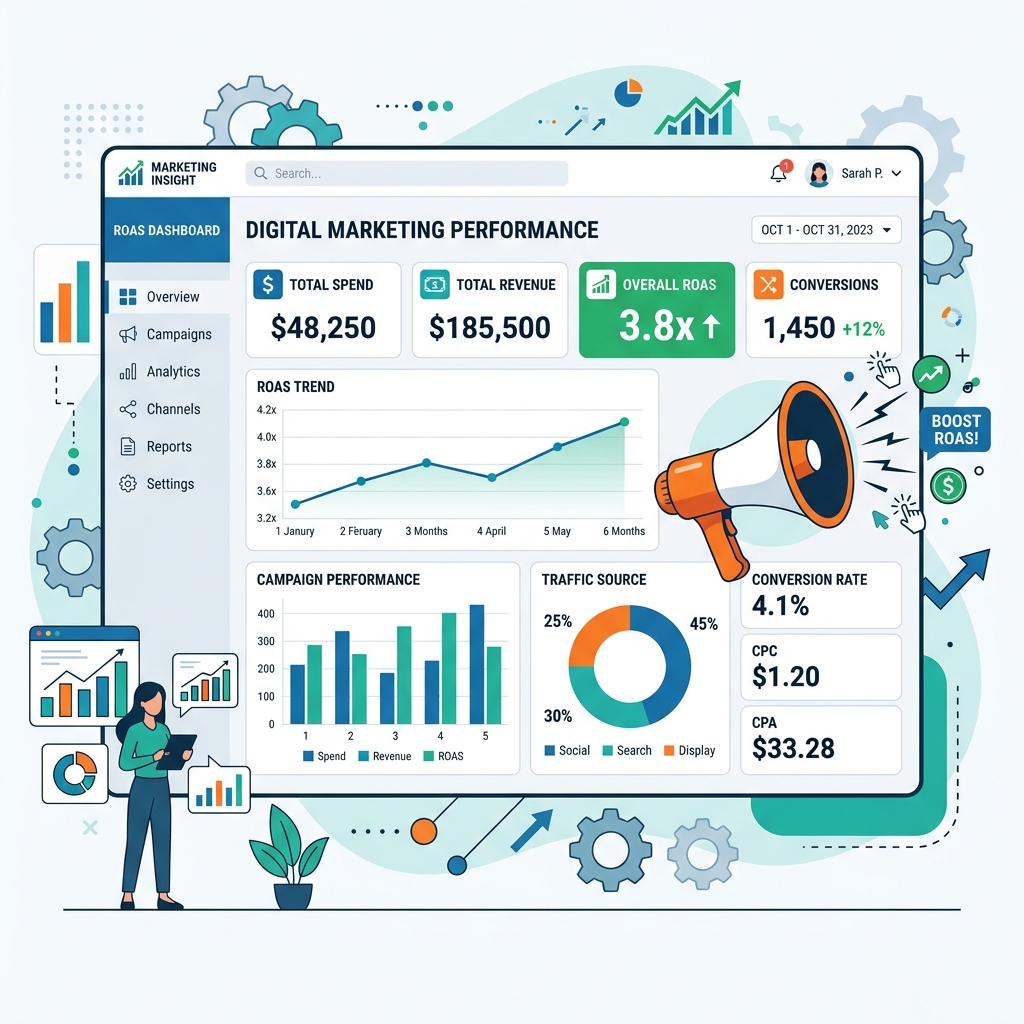
Understanding ROAS vs. CAC: Don't Let Vanity Metrics Fool You
In the high-stakes world of digital marketing, data is everywhere. Dashboards flash green and red, algorithms dictate strategy, and millions of dollars are deployed based on real-time analytics. However, relying on the wrong metrics can lead a business straight off a financial cliff. The most common and destructive example of this is the obsession with ROAS (Return on Ad Spend) while ignoring the true king of profitability: CAC (Customer Acquisition Cost).
The Allure and Deception of ROAS
Digital marketers and ad agencies love to boast about a 5x or 10x ROAS. It sounds incredible on a weekly report: "For every $1 we put into Facebook Ads, we get $5 back in revenue!" This metric is easy to calculate, highly visible in ad manager dashboards, and provides a quick dopamine hit.
Formula: ROAS = Gross Revenue from Ad Campaign / Cost of Ad Campaign
The problem? ROAS is a highly deceptive metric because it exists in a vacuum. It only measures gross revenue against the direct cost of the advertising clicks. It completely ignores the brutal reality of running an actual business.
What ROAS Leaves Out
If you sell a physical product for $100 and it cost you $20 in ads to acquire that sale, your ROAS is 5x. Sounds great, right? But let's look at the hidden costs:
- Cost of Goods Sold (COGS): The product costs $40 to manufacture.
- Shipping and Fulfillment: It costs $15 to pick, pack, and ship the item.
- Payment Processing Fees: The credit card company takes $3 (3%).
- Operational Overhead: You have software subscriptions, customer service reps, and warehouse rent to pay. Let's say that averages to $10 per order.
- Agency/Labor Costs: You are paying an agency $5,000 a month to manage those ads, which adds another $5 per order.
Suddenly, that $100 in revenue is eaten up by $73 in operational costs PLUS the $20 ad spend. Your total cost is $93. You made a mere $7 profit on a 5x ROAS. If your ROAS drops to 4x (a $25 ad cost), you are actively losing money on every single sale, despite the dashboard telling you the campaign is highly "successful."
Why CAC is the True Measure of Efficiency
Customer Acquisition Cost (CAC) cuts through the noise and provides the fully loaded, brutal truth about your marketing efficiency. It factors in ALL expenses required to convince a customer to buy your product or service.
Formula: CAC = Total Marketing & Sales Expenses / Number of New Customers Acquired
Crucially, "Total Marketing & Sales Expenses" doesn't just mean ad spend. It includes the salaries of your marketing team, the commissions paid to sales reps, the cost of your CRM and email software, the agency retainer fees, and the cost of producing creative assets (videos, graphics, copy).
By calculating a fully loaded CAC, you know exactly how much cash leaves your bank account every time a new customer arrives.
The Golden Ratio: LTV to CAC
Knowing your CAC is useless unless you compare it to the Lifetime Value (LTV) of that customer. If it costs you $100 to acquire a customer, and they only ever spend $50 with you, your business will fail rapidly. If they spend $50 every month for three years, your business is a gold mine.
The LTV:CAC ratio is the ultimate indicator of a sustainable business model.
- 1:1 Ratio: You are losing money on every customer (due to COGS and overhead).
- 3:1 Ratio: This is generally considered the benchmark for a healthy, sustainable business. You make three times what you spend to acquire the customer.
- 5:1 Ratio or Higher: While this looks great, it might actually indicate that you are under-investing in marketing. You could likely grow much faster by spending more aggressively to capture market share, even if it slightly lowers your ratio.
Shifting Your Strategy
Transitioning your focus from ROAS to CAC requires a fundamental shift in how you evaluate campaigns and allocate budget.
First, stop evaluating marketing channels in silos. If your Facebook Ads show a 4x ROAS and your Google Ads show a 2x ROAS, the instinct is to turn off Google and double down on Facebook. However, if your Google Ads are driving high-LTV B2B clients and Facebook is driving low-LTV one-time buyers, optimizing for ROAS will destroy your long-term profitability.
Second, demand fully loaded reporting from your marketing team or agency. Do not accept dashboards that only show platform-level ROAS. Integrate your marketing data with your financial software to calculate a blended CAC across all channels, factoring in all associated overhead.
Conclusion: Profit is the Only Metric That Matters
ROAS is a useful tactical metric for day-to-day campaign optimization within a specific platform. However, it should never be used as a strategic KPI for business health. By shifting your focus to fully loaded CAC and measuring it against customer LTV, you ensure that your marketing efforts are actually driving sustainable profit, not just hollow revenue.