
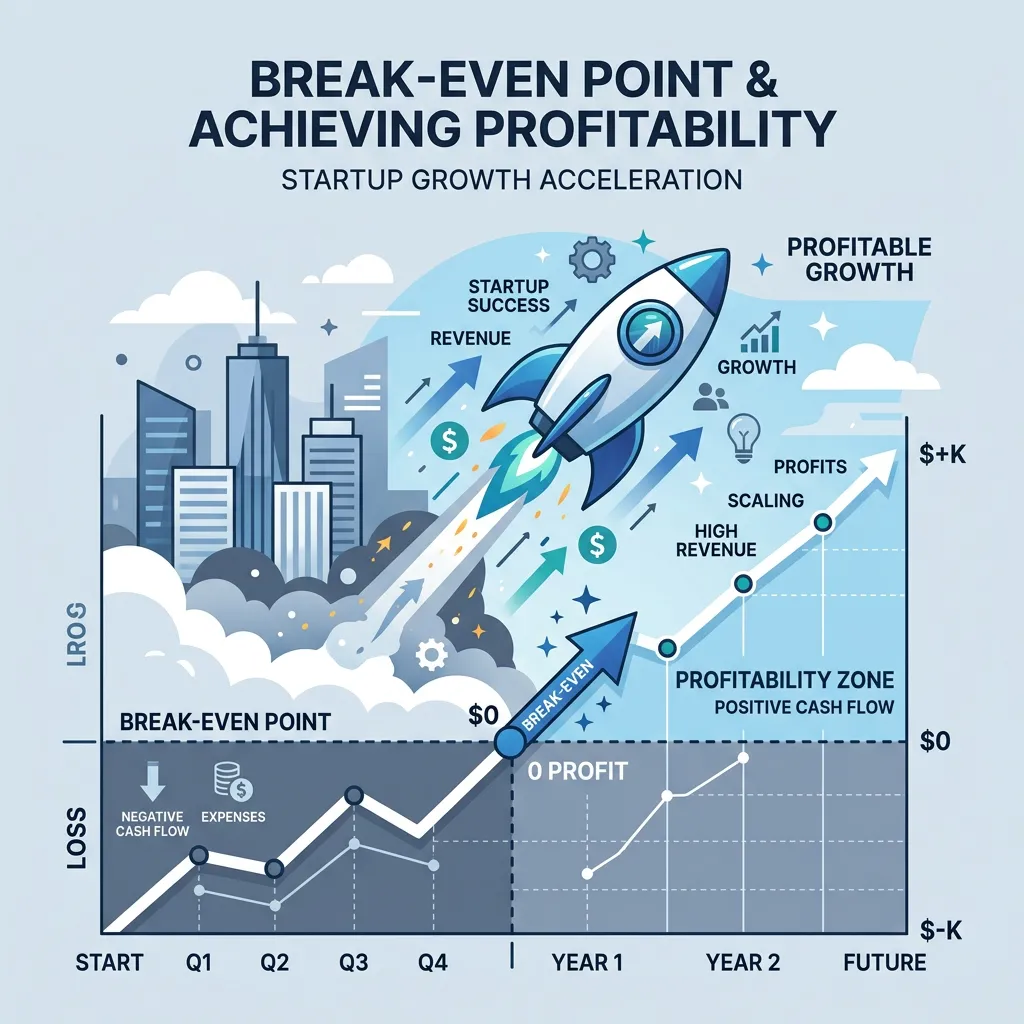
Introduction: Why the Break-Even Calculation Matters
Startups often burn through runway because founders lack a clear understanding of their break-even point. This critical metric defines the exact moment your total revenue equals your total costs (fixed plus variable). Without knowing this number, pricing strategies become guesswork, and scaling efforts can inadvertently accelerate cash burn. Calculating and continuously monitoring your break-even threshold provides a tangible, mathematical target for the entire organization, aligning sales goals directly with financial survival.
In today's highly interconnected global economy, establishing a robust financial foundation is no longer just an option—it is a critical necessity for survival and long-term prosperity. As markets become increasingly saturated and competition intensifies across every sector, the margin for error in financial planning and execution has shrunk significantly. Many professionals and businesses operate under the assumption that top-line revenue growth will naturally resolve any underlying operational inefficiencies. However, this is a dangerous misconception. Without a deep, granular understanding of the mechanics that drive profitability, even the most innovative products and services can succumb to cash flow crises, regulatory penalties, or unsustainable cost structures. Understanding the foundational principles of this topic empowers decision-makers to pivot strategically, optimize their resource allocation, and build resilience against unforeseen market fluctuations.
Furthermore, the advent of digital transformation has democratized access to advanced financial tools and analytics, meaning that your competitors are likely already leveraging these insights to capture market share. To maintain a competitive edge, it is imperative to shift from a reactive financial posture to a proactive one. This involves not only grasping the high-level concepts but also meticulously applying them to your daily operational workflows. Whether you are an independent freelancer navigating the complexities of international trade, a growing startup trying to optimize your burn rate, or an established enterprise seeking to refine your cost control measures, the principles discussed here will serve as a compass. By integrating these strategies into your core business model, you can unlock hidden value, streamline your administrative overhead, and ultimately drive sustainable, scalable growth that withstands the test of time.
The Mechanics of Break-Even Analysis
- Fixed Costs: Expenses that do not change regardless of sales volume (e.g., office rent, salaries, software subscriptions, insurance).
- Variable Costs: Expenses that increase proportionally with each unit sold (e.g., raw materials, payment processing fees, direct shipping costs).
- Unit Selling Price: The gross price a customer pays for one unit of your product or service.
- Contribution Margin per Unit: Unit Selling Price - Variable Cost per Unit. This is the amount each sale contributes to paying down fixed costs.
- Break-Even Point (in Units): Total Fixed Costs / Contribution Margin per Unit.
Implementing these frameworks requires a systematic approach and a commitment to continuous monitoring. It is not enough to simply run a calculation once and assume the job is done. Financial metrics are dynamic; they evolve in tandem with your business, influenced by external economic pressures, shifts in consumer behavior, and internal operational changes. Therefore, establishing a routine cadence for reviewing and updating these figures is paramount. This might involve setting up automated dashboards, conducting monthly financial reviews with your team, or partnering with specialized advisors who can provide objective, data-driven perspectives. The goal is to create a feedback loop where financial insights directly inform strategic decisions, ensuring that every dollar spent or earned is maximizing its potential impact on your bottom line.
Moreover, the psychological aspect of financial mastery cannot be overstated. Ambiguity breeds anxiety, whereas clarity breeds confidence. When you have a precise understanding of your financial mechanics, you are better equipped to negotiate contracts, set competitive yet profitable pricing, and weather temporary downturns without resorting to panic-driven measures. This level of financial literacy transforms your role from a mere operator to a visionary leader capable of steering the organization toward its long-term objectives. As we delve deeper into the specific formulas, real-world applications, and frequently asked questions, keep in mind that these tools are designed to empower you. They are the building blocks of a resilient business architecture that can adapt, thrive, and consistently deliver value to both you and your stakeholders.
In conclusion, embracing these methodologies is a continuous journey rather than a destination. The landscape of commerce is ever-shifting, with new regulatory requirements, technological advancements, and economic paradigms emerging regularly. Staying informed and agile is your best defense against obsolescence. We encourage you to not only absorb the information presented but to actively test and refine these models within the context of your own unique business environment. The theoretical knowledge is only as valuable as its practical application. By taking deliberate, calculated steps to implement these strategies today, you are laying the groundwork for a more profitable, secure, and successful tomorrow.
Real-World Scenario: Lowering the Threshold
Consider a direct-to-consumer (DTC) startup selling premium ergonomic office chairs. Their monthly fixed costs for warehouse space, core staff salaries, and marketing retainers total $50,000. Each chair sells for $400. The variable costs per chair (manufacturing, packaging, and shipping) amount to $200. This leaves a contribution margin of $200 per chair ($400 - $200). To calculate their break-even point, they divide their $50,000 fixed costs by the $200 contribution margin, meaning they must sell exactly 250 chairs every month just to avoid losing money. If they are only averaging 200 sales a month, they are bleeding cash. To reach profitability, the founders have three distinct levers: increase the selling price to $450 (boosting contribution margin), negotiate with suppliers to drop variable costs to $150, or downsize their warehouse to lower fixed costs to $40,000. By choosing to renegotiate their shipping contracts to lower variable costs by $25 and trimming software subscriptions to save $5,000 in fixed costs, their new break-even point drops to exactly 200 units, instantly pushing the company into a state of operational profitability without needing to acquire a single new customer.
Frequently Asked Questions
Is marketing a fixed or variable cost?
It depends. A fixed monthly retainer paid to an agency is a fixed cost. However, pay-per-click (PPC) ad spend tied directly to customer acquisition is often treated as a variable cost in unit economics.
Why is the break-even point so important for investors?
Investors use the break-even point to evaluate the risk and scalability of a business model. A lower break-even point indicates a more resilient business that can survive market downturns and scale profitably.
How often should I recalculate my break-even point?
Startups should recalculate it at least quarterly, or immediately following any significant pricing changes, major new hires, or shifts in supplier costs.