
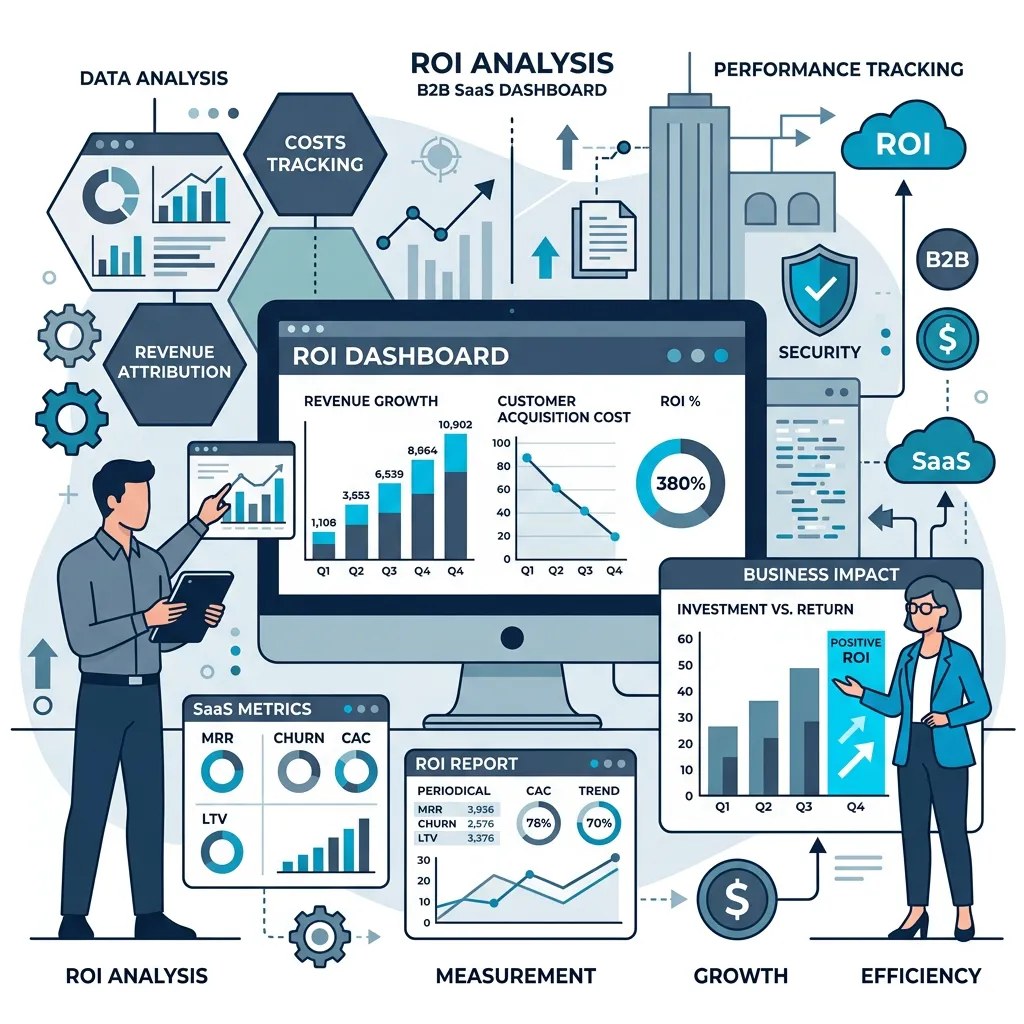
Introduction: Why Measuring B2B SaaS ROI Matters
The modern B2B SaaS ecosystem is saturated with specialized tools, each promising to revolutionize your workflow, boost productivity, and drive exponential growth. However, purchasing a software subscription is only the very first step in a complex adoption journey. In today's highly competitive business environment, failing to accurately measure the Return on Investment (ROI) of your software tools can lead to profound financial inefficiencies and operational bloat. Business leaders often fall into the trap of looking solely at the monthly or annual subscription cost, completely overlooking the hidden expenditures that accompany new technology deployments. These hidden costs can severely impact your bottom line.
The true cost of SaaS adoption extends far beyond the sticker price. It includes the labor hours spent on employee training, the intricacies of data migration from legacy systems, and the temporary but significant loss of productivity during the onboarding phase. Furthermore, poorly integrated tools can create data silos, requiring manual workarounds that defeat the purpose of automation in the first place. When you fail to account for these factors, what appears to be a cheap operational upgrade can actually become a massive drain on your company's financial and human resources.
To accurately measure ROI before you buy, you must take a holistic approach to cost analysis. This means comparing these comprehensive upfront and ongoing costs against the projected net returns. These returns could manifest as increased sales conversions, a reduction in total labor hours required for specific tasks, or a significant decrease in costly human error rates. A rigorous ROI calculation acts as a financial safeguard. It prevents tech-stack bloat, ensures capital is deployed effectively, and guarantees that every software tool you integrate genuinely contributes to your organization's overarching strategic objectives.
Mechanics & Formula Breakdown
Understanding the mechanics of SaaS ROI requires breaking down the core financial formula and understanding every variable involved. The basic formula is straightforward, but the inputs require meticulous calculation:
- The Core Formula: ROI (%) = [(Net Profit from Investment - Total Cost of Investment) / Total Cost of Investment] x 100. This percentage tells you the efficiency and profitability of the software over a given period.
- Calculating Total Cost of Investment (TCO): This goes beyond the licensing fee. TCO = Annual Subscription Fee + Implementation Costs + Training Costs + Integration/API Fees + Cost of Productivity Loss During Transition. You must assign a dollar value to the time your team spends learning the new system.
- Quantifying Net Profit/Returns: This is often the hardest part. You must estimate the financial value of the benefits. Returns = (Hours Saved per Week x Average Hourly Wage) + New Revenue Generated + Costs Avoided (e.g., reducing error-related refunds).
- The Payback Period: This is the amount of time it takes for the software to pay for itself. Payback Period (in months) = Total Upfront Cost / Monthly Net Benefit. A shorter payback period drastically reduces financial risk.
- Adoption Rate Multiplier: A software tool only delivers value if employees use it. If only 50% of your staff adopts the tool, your projected returns must be multiplied by 0.5. ROI calculations must always factor in realistic user adoption rates.
Real-World Scenario: Implementing a New CRM
Consider a mid-sized marketing agency with 50 employees looking to implement a new, advanced Customer Relationship Management (CRM) platform. The base cost of the CRM is $20,000 per year. In the past, the agency might have simply looked at this $20,000 and assumed that was their total risk. However, a proper ROI analysis reveals a different picture.
The agency estimates that implementation and data migration will require 40 hours of work from an external consultant billing at $150 per hour, adding $6,000 to the upfront cost. Additionally, all 50 employees must undergo 5 hours of training. If the average employee cost to the company (salary plus benefits) is $50 per hour, this represents $12,500 in lost billable time and wages. The Total Cost of Investment for year one is now $38,500, nearly double the subscription cost.
On the return side, the agency projects that the CRM's automation features will save each employee 2 hours per week. Across 50 employees over a 48-week working year, this equates to 4,800 hours saved. At $50 per hour, the gross savings are a staggering $240,000. Additionally, the improved lead tracking is expected to close 5 extra deals a year, generating $50,000 in net new profit. Total returns equal $290,000.
Using the formula: [($290,000 - $38,500) / $38,500] x 100, the projected first-year ROI is 653%. Even if the agency accounts for a 20% margin of error due to lower-than-expected adoption, the investment remains highly lucrative. This detailed scenario demonstrates how looking past the initial sticker price allows businesses to confidently invest in transformative technology while absorbing the necessary transition costs.
Step-by-Step FAQ
Step 1: How do I measure "soft" savings like improved employee morale?
While difficult to quantify directly, soft savings often translate into hard metrics eventually. Improved morale generally leads to reduced employee turnover. You can measure this by calculating your average cost of hiring and onboarding a new employee, and estimating the financial savings if the new software reduces your annual turnover rate by a certain percentage.
Step 2: Should I calculate ROI over 1 year or 3 years?
It is best practice to calculate both. A 1-year ROI gives you the immediate financial impact and helps manage short-term cash flow. A 3-year ROI is generally more favorable because upfront implementation and training costs are amortized over a longer period, while the compounding benefits of efficiency continue to grow year over year.
Step 3: What happens if the projected ROI is negative?
If your calculation yields a negative ROI, you should pause the purchase immediately. A negative ROI indicates that the cost of the software and its implementation outweighs the tangible benefits. In this case, you should either negotiate a lower price, seek out a more affordable alternative, or re-evaluate whether your team truly needs a new solution for the problem at hand.
Step 4: How often should I review the ROI after purchasing?
You should conduct a post-implementation review at the 6-month and 12-month marks. Compare your initial projections against the actual data. Are employees saving the time you predicted? Was the implementation cost accurate? This retrospective analysis not only validates your current investment but makes your future ROI predictions much more accurate.
Step 5: How does user adoption affect the final ROI calculation?
User adoption is the single biggest point of failure for SaaS ROI. If a tool promises to save 10 hours a week but only half your team uses it, your returns are slashed by 50%, while your fixed subscription costs remain the same. Always include a realistic adoption rate in your formula and invest heavily in change management to drive usage.