
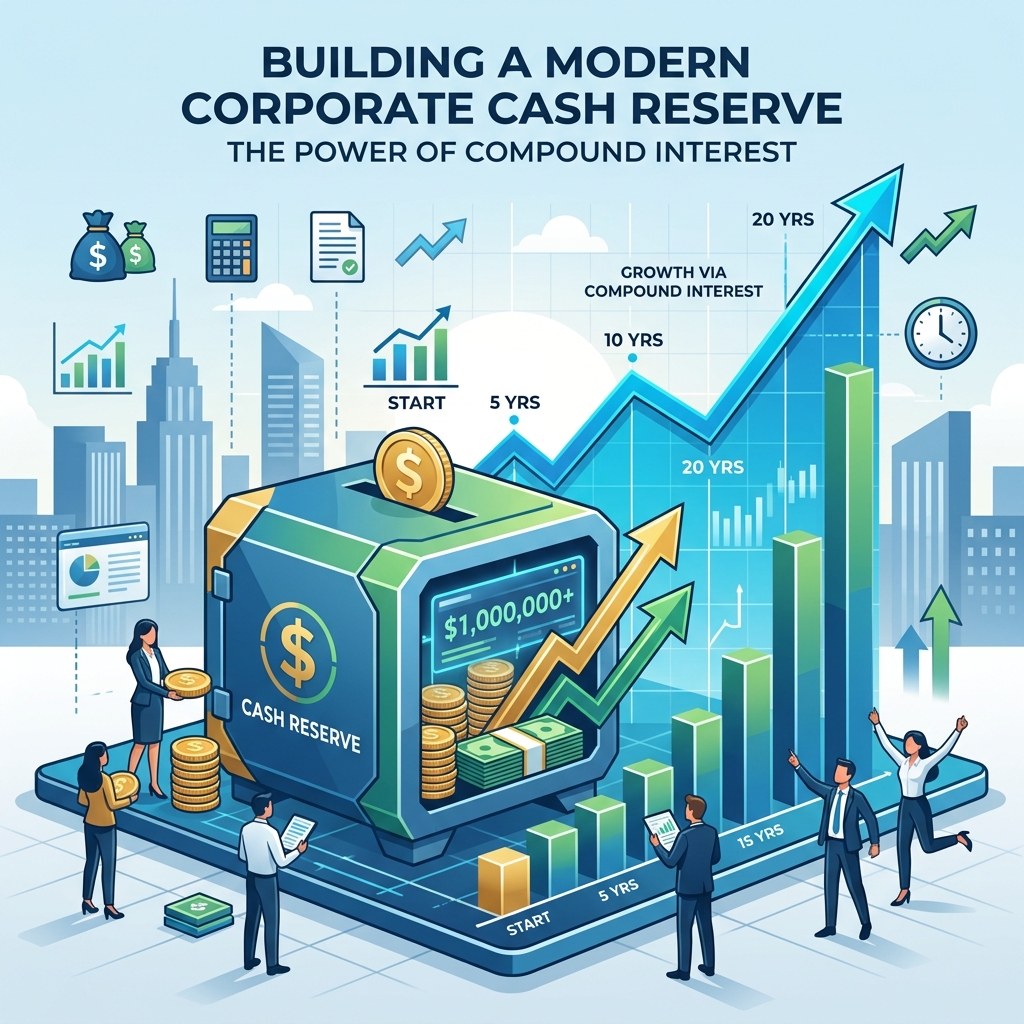
The Power of Compound Interest for Business Cash Reserves
Albert Einstein allegedly called compound interest the "eighth wonder of the world." Leveraging compound interest is a critical strategy for corporate treasury management.
The Hidden Cost of Idle Cash
Compound interest is often hailed as the eighth wonder of the world. For businesses, allowing excess cash to sit idle in a low-interest checking account is a missed opportunity. By investing reserves into high-yield accounts, businesses can generate a significant secondary income stream. This passive income can be used to fund operations, hire new employees, or cushion against economic downturns. Inflation constantly erodes purchasing power, making it essential to earn a return on cash reserves. Strategic treasury management separates sophisticated companies from those that simply survive. Every dollar earned through interest is a dollar that did not require customer acquisition costs. As interest compounds over time, the growth curve becomes increasingly steep, multiplying wealth exponentially.
Compound interest is often hailed as the eighth wonder of the world. For businesses, allowing excess cash to sit idle in a low-interest checking account is a missed opportunity. By investing reserves into high-yield accounts, businesses can generate a significant secondary income stream. This passive income can be used to fund operations, hire new employees, or cushion against economic downturns. Inflation constantly erodes purchasing power, making it essential to earn a return on cash reserves. Strategic treasury management separates sophisticated companies from those that simply survive. Every dollar earned through interest is a dollar that did not require customer acquisition costs. As interest compounds over time, the growth curve becomes increasingly steep, multiplying wealth exponentially.
Understanding the Mechanics of Compound Interest
Compound interest is often hailed as the eighth wonder of the world. For businesses, allowing excess cash to sit idle in a low-interest checking account is a missed opportunity. By investing reserves into high-yield accounts, businesses can generate a significant secondary income stream. This passive income can be used to fund operations, hire new employees, or cushion against economic downturns. Inflation constantly erodes purchasing power, making it essential to earn a return on cash reserves. Strategic treasury management separates sophisticated companies from those that simply survive. Every dollar earned through interest is a dollar that did not require customer acquisition costs. As interest compounds over time, the growth curve becomes increasingly steep, multiplying wealth exponentially.
Compound interest is often hailed as the eighth wonder of the world. For businesses, allowing excess cash to sit idle in a low-interest checking account is a missed opportunity. By investing reserves into high-yield accounts, businesses can generate a significant secondary income stream. This passive income can be used to fund operations, hire new employees, or cushion against economic downturns. Inflation constantly erodes purchasing power, making it essential to earn a return on cash reserves. Strategic treasury management separates sophisticated companies from those that simply survive. Every dollar earned through interest is a dollar that did not require customer acquisition costs. As interest compounds over time, the growth curve becomes increasingly steep, multiplying wealth exponentially.
- Compound interest is often hailed as the eighth wonder of the world.
- For businesses, allowing excess cash to sit idle in a low-interest checking account is a missed opportunity.
- By investing reserves into high-yield accounts, businesses can generate a significant secondary income stream.
How Inflation Erodes Your Purchasing Power
Compound interest is often hailed as the eighth wonder of the world. For businesses, allowing excess cash to sit idle in a low-interest checking account is a missed opportunity. By investing reserves into high-yield accounts, businesses can generate a significant secondary income stream. This passive income can be used to fund operations, hire new employees, or cushion against economic downturns. Inflation constantly erodes purchasing power, making it essential to earn a return on cash reserves. Strategic treasury management separates sophisticated companies from those that simply survive. Every dollar earned through interest is a dollar that did not require customer acquisition costs. As interest compounds over time, the growth curve becomes increasingly steep, multiplying wealth exponentially.
Compound interest is often hailed as the eighth wonder of the world. For businesses, allowing excess cash to sit idle in a low-interest checking account is a missed opportunity. By investing reserves into high-yield accounts, businesses can generate a significant secondary income stream. This passive income can be used to fund operations, hire new employees, or cushion against economic downturns. Inflation constantly erodes purchasing power, making it essential to earn a return on cash reserves. Strategic treasury management separates sophisticated companies from those that simply survive. Every dollar earned through interest is a dollar that did not require customer acquisition costs. As interest compounds over time, the growth curve becomes increasingly steep, multiplying wealth exponentially.
Types of High-Yield Accounts for Businesses
Compound interest is often hailed as the eighth wonder of the world. For businesses, allowing excess cash to sit idle in a low-interest checking account is a missed opportunity. By investing reserves into high-yield accounts, businesses can generate a significant secondary income stream. This passive income can be used to fund operations, hire new employees, or cushion against economic downturns. Inflation constantly erodes purchasing power, making it essential to earn a return on cash reserves. Strategic treasury management separates sophisticated companies from those that simply survive. Every dollar earned through interest is a dollar that did not require customer acquisition costs. As interest compounds over time, the growth curve becomes increasingly steep, multiplying wealth exponentially.
Compound interest is often hailed as the eighth wonder of the world. For businesses, allowing excess cash to sit idle in a low-interest checking account is a missed opportunity. By investing reserves into high-yield accounts, businesses can generate a significant secondary income stream. This passive income can be used to fund operations, hire new employees, or cushion against economic downturns. Inflation constantly erodes purchasing power, making it essential to earn a return on cash reserves. Strategic treasury management separates sophisticated companies from those that simply survive. Every dollar earned through interest is a dollar that did not require customer acquisition costs. As interest compounds over time, the growth curve becomes increasingly steep, multiplying wealth exponentially.
Building a Corporate Treasury Management Strategy
Compound interest is often hailed as the eighth wonder of the world. For businesses, allowing excess cash to sit idle in a low-interest checking account is a missed opportunity. By investing reserves into high-yield accounts, businesses can generate a significant secondary income stream. This passive income can be used to fund operations, hire new employees, or cushion against economic downturns. Inflation constantly erodes purchasing power, making it essential to earn a return on cash reserves. Strategic treasury management separates sophisticated companies from those that simply survive. Every dollar earned through interest is a dollar that did not require customer acquisition costs. As interest compounds over time, the growth curve becomes increasingly steep, multiplying wealth exponentially.
Compound interest is often hailed as the eighth wonder of the world. For businesses, allowing excess cash to sit idle in a low-interest checking account is a missed opportunity. By investing reserves into high-yield accounts, businesses can generate a significant secondary income stream. This passive income can be used to fund operations, hire new employees, or cushion against economic downturns. Inflation constantly erodes purchasing power, making it essential to earn a return on cash reserves. Strategic treasury management separates sophisticated companies from those that simply survive. Every dollar earned through interest is a dollar that did not require customer acquisition costs. As interest compounds over time, the growth curve becomes increasingly steep, multiplying wealth exponentially.
Balancing Liquidity and Yield
Compound interest is often hailed as the eighth wonder of the world. For businesses, allowing excess cash to sit idle in a low-interest checking account is a missed opportunity. By investing reserves into high-yield accounts, businesses can generate a significant secondary income stream. This passive income can be used to fund operations, hire new employees, or cushion against economic downturns. Inflation constantly erodes purchasing power, making it essential to earn a return on cash reserves. Strategic treasury management separates sophisticated companies from those that simply survive. Every dollar earned through interest is a dollar that did not require customer acquisition costs. As interest compounds over time, the growth curve becomes increasingly steep, multiplying wealth exponentially.
Compound interest is often hailed as the eighth wonder of the world. For businesses, allowing excess cash to sit idle in a low-interest checking account is a missed opportunity. By investing reserves into high-yield accounts, businesses can generate a significant secondary income stream. This passive income can be used to fund operations, hire new employees, or cushion against economic downturns. Inflation constantly erodes purchasing power, making it essential to earn a return on cash reserves. Strategic treasury management separates sophisticated companies from those that simply survive. Every dollar earned through interest is a dollar that did not require customer acquisition costs. As interest compounds over time, the growth curve becomes increasingly steep, multiplying wealth exponentially.
The Impact of Compounding Over 5, 10, and 20 Years
Compound interest is often hailed as the eighth wonder of the world. For businesses, allowing excess cash to sit idle in a low-interest checking account is a missed opportunity. By investing reserves into high-yield accounts, businesses can generate a significant secondary income stream. This passive income can be used to fund operations, hire new employees, or cushion against economic downturns. Inflation constantly erodes purchasing power, making it essential to earn a return on cash reserves. Strategic treasury management separates sophisticated companies from those that simply survive. Every dollar earned through interest is a dollar that did not require customer acquisition costs. As interest compounds over time, the growth curve becomes increasingly steep, multiplying wealth exponentially.
Compound interest is often hailed as the eighth wonder of the world. For businesses, allowing excess cash to sit idle in a low-interest checking account is a missed opportunity. By investing reserves into high-yield accounts, businesses can generate a significant secondary income stream. This passive income can be used to fund operations, hire new employees, or cushion against economic downturns. Inflation constantly erodes purchasing power, making it essential to earn a return on cash reserves. Strategic treasury management separates sophisticated companies from those that simply survive. Every dollar earned through interest is a dollar that did not require customer acquisition costs. As interest compounds over time, the growth curve becomes increasingly steep, multiplying wealth exponentially.
Case Study: A Small Business Earning $50k Annually in Passive Income
Compound interest is often hailed as the eighth wonder of the world. For businesses, allowing excess cash to sit idle in a low-interest checking account is a missed opportunity. By investing reserves into high-yield accounts, businesses can generate a significant secondary income stream. This passive income can be used to fund operations, hire new employees, or cushion against economic downturns. Inflation constantly erodes purchasing power, making it essential to earn a return on cash reserves. Strategic treasury management separates sophisticated companies from those that simply survive. Every dollar earned through interest is a dollar that did not require customer acquisition costs. As interest compounds over time, the growth curve becomes increasingly steep, multiplying wealth exponentially.
Compound interest is often hailed as the eighth wonder of the world. For businesses, allowing excess cash to sit idle in a low-interest checking account is a missed opportunity. By investing reserves into high-yield accounts, businesses can generate a significant secondary income stream. This passive income can be used to fund operations, hire new employees, or cushion against economic downturns. Inflation constantly erodes purchasing power, making it essential to earn a return on cash reserves. Strategic treasury management separates sophisticated companies from those that simply survive. Every dollar earned through interest is a dollar that did not require customer acquisition costs. As interest compounds over time, the growth curve becomes increasingly steep, multiplying wealth exponentially.